

Secondary Processes in Ammunition Production
In ammunition manufacturing, the highest-profile stages are often the forming, loading, assembly, and inspection processes. These operations shape the case, form the projectile, seat the primer, charge the cartridge, and verify the final round. However, the secondary processes that support those primary operations are just as important to quality, consistency, and long-term production efficiency.
Washing, pickling, polishing, and wastewater treatment are not afterthoughts in a modern ammunition production environment. They are essential processes that help remove residues, prepare surfaces, improve corrosion resistance, support downstream operations, and maintain cleaner, more controlled manufacturing conditions.
For manufacturers looking to improve yield and reduce defects, these secondary processes must be treated as part of the full production system. When properly integrated, they support better forming, cleaner assembly, more consistent inspection results, and more efficient plant operations.
Why Secondary Processes Matter in Ammunition Manufacturing
Ammunition production places significant stress on brass, copper, steel, lead, and other materials. During forming, drawing, annealing, trimming, machining, loading, and assembly, components are exposed to lubricants, oxides, scale, burrs, fines, dust, and process residues. If these contaminants are not properly managed, they can create issues throughout the line.
A case that leaves a forming operation with residual lubricant may interfere with handling or inspection. A component that exits annealing with heavy oxidation may require surface preparation before additional processing. A finished cartridge with inconsistent surface finish may create quality concerns even if its dimensions are within tolerance.
Secondary processing helps control these variables before they become larger production problems. In high-volume environments, this is especially important because small surface or cleanliness issues can compound quickly across thousands or millions of parts.
Effective secondary processing can support:
- Cleaner brass cases, cups, bullets, and finished cartridges
- More consistent downstream forming and assembly
- Reduced surface defects, residue, and oxidation
- Improved corrosion resistance and finished appearance
- Better process control across high-volume production lines
These steps are not separate from manufacturing performance. They directly influence the reliability and repeatability of the entire ammunition production system.
Washing Systems for Removing Fluids, Residues, and Contamination
Washing is one of the most important secondary processes in ammunition production because it removes the process fluids and contaminants created during earlier manufacturing stages. Drawing compounds, coolants, lubricants, metal fines, and surface residues must be managed before components move into the next phase of production.
In case manufacturing, washing is especially important after drawing and forming operations. Lubricants are necessary for reducing friction, controlling heat, and protecting tooling, but they cannot remain on the component indefinitely. If fluids are carried into annealing, inspection, loading, or packaging, they may create quality issues or interfere with process repeatability.
Modern ammunition washing systems are designed to clean components efficiently without damaging delicate features such as case mouths, shoulders, primer pockets, or projectile surfaces. The right system depends on the component type, production volume, contamination level, and where the wash stage sits within the line.
The goal is not simply to make parts look cleaner. Washing supports manufacturing stability by creating a more consistent surface condition for the next operation. When parts enter downstream equipment in a cleaner and more predictable state, manufacturers can reduce variability and improve throughput.
Pickling for Oxide Removal and Surface Preparation
Pickling is commonly used after heat-based processes such as annealing, where oxidation and scale can develop on brass or other metal components. These surface oxides may be expected in certain operations, but they still need to be controlled depending on the application, component type, and final quality requirements.
In ammunition production, pickling helps remove oxides, scale, and surface discoloration from cups, cases, bullets, and related components. This process prepares the surface for further handling, finishing, assembly, or inspection.
The value of pickling is not limited to appearance. Surface condition affects how components move through equipment, how they respond to additional processing, and how reliably they can be inspected. Heavy or uneven oxidation can create inconsistencies that make downstream operations less predictable.
A well-designed pickling process must account for the material, component geometry, previous operations, and production goals. Brass cases, cups, and projectile components may each require different handling approaches. The system must also balance cleaning effectiveness with part protection, ensuring oxides are removed without overprocessing the component.
In a properly integrated ammunition production line, pickling is not treated as a generic metal cleaning step. It is engineered around the realities of ammunition manufacturing, including caliber range, production volume, surface finish requirements, and downstream process sensitivity.
Polishing and Burnishing for Finish Quality and Performance
Polishing plays a major role in both finished appearance and functional consistency. Ammunition components must meet dimensional and performance requirements, but surface quality also matters. Burrs, tarnish, oxidation, carbon residue, and minor imperfections can all affect how components move through handling, inspection, packaging, or end-use environments.
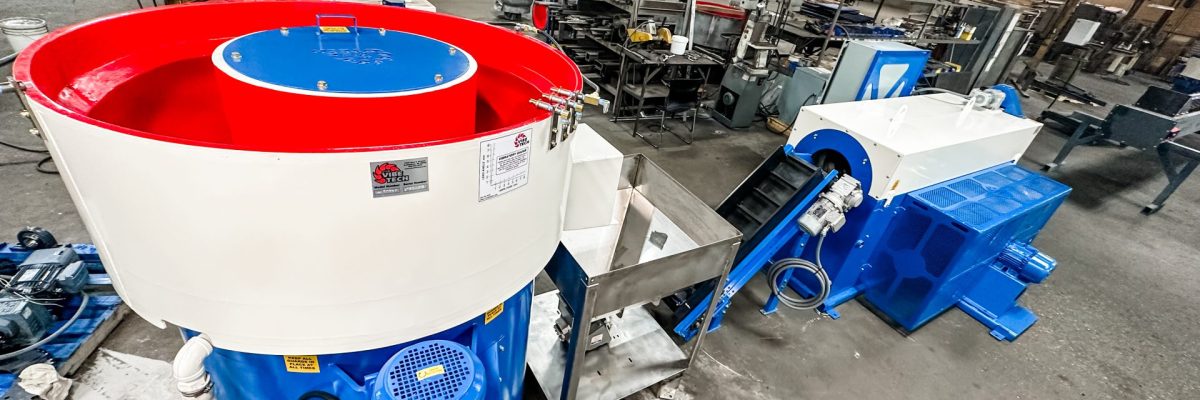
Ammunition polishing systems may use dry media, wet burnishing, vibratory finishing, centrifugal finishing, barrel finishing, or other mass finishing methods depending on the application. The right approach depends on whether the manufacturer is processing new brass, remanufactured brass, projectiles, or finished cartridges.
Polishing can help improve:
- Surface brightness and uniformity
- Burr and edge condition
- Residue removal
- Corrosion resistance
- Finished product consistency and presentation
In high-volume production, polishing must be repeatable. A process that works well for one batch but varies across longer runs can create inconsistent results and unnecessary rework. Media selection, cycle control, part loading, fluid chemistry, and drying must all be aligned with the manufacturer’s quality goals.
The best polishing systems are not selected based on shine alone. They are selected based on the full production requirement: the type of component, the desired surface condition, the level of automation needed, and how the process connects to inspection, packaging, or additional manufacturing steps.
Wastewater Treatment as a Core Production Requirement
Any operation that uses washing, pickling, wet burnishing, or chemical finishing must also account for wastewater. In ammunition manufacturing, wastewater may contain residues from metalworking fluids, cleaning compounds, polishing media, acids, dissolved metals, suspended solids, and other process-related contaminants.
Because of this, wastewater treatment should be planned as part of the manufacturing system rather than handled as a separate concern after equipment is installed. A production line that cleans effectively but creates unmanaged wastewater can create operational, environmental, and compliance challenges.
A properly engineered wastewater approach helps manufacturers manage the byproducts of secondary processing while supporting stable production. This may involve separating solids, adjusting chemistry, reducing suspended contaminants, and preparing wastewater for proper handling or discharge based on facility requirements.
From a manufacturing perspective, wastewater treatment also helps create a more sustainable and predictable operation. When chemistry, water use, and waste streams are understood from the beginning, manufacturers can improve efficiency and reduce the risk of costly disruptions.
Integrating Washing, Pickling, Polishing, and Wastewater Treatment
Secondary processes provide the greatest value when they are integrated into the larger ammunition production line. Standalone systems may solve individual problems, but disconnected equipment can create bottlenecks, inconsistent handling, and unnecessary manual labor.
A systems-based approach looks at how each process connects to the next. Washing may need to support annealing or inspection. Pickling may need to follow heat treatment while preserving required surface characteristics. Polishing may need to prepare finished cartridges for packaging. Wastewater treatment must support the entire wet processing environment.
Integration can include feeding and conveying systems, automated loading and unloading, programmable controls, process monitoring, drying systems, and facility-specific layout planning. These details matter because secondary processes must keep pace with production without introducing delays.
When these systems are engineered together, manufacturers can improve both quality and efficiency. Parts move more predictably, operators have better control over process conditions, and production teams gain a clearer understanding of where surface quality issues originate.
Reducing Defects Through Better Surface Control
Many ammunition defects are tied to small variations that appear early in the process. Surface contamination, excessive residue, oxide buildup, burrs, or inconsistent finish may seem minor at first, but these issues can affect downstream performance.
For example, residue left on a case may interfere with inspection accuracy. Oxidation may create inconsistent appearance or affect subsequent handling. Burrs may contribute to feeding issues within equipment. Poor drying may lead to spotting or corrosion concerns.
Secondary processing reduces these risks by creating cleaner, more uniform components before they move forward. This helps operators separate true dimensional or assembly defects from surface-related issues that could have been corrected earlier in the process.
The result is a more stable production environment with fewer preventable defects and less unnecessary rework.
A More Complete Approach to Ammunition Production
Ammunition manufacturers cannot maximize quality by focusing only on presses, loading machines, and inspection systems. The supporting processes around washing, pickling, polishing, and wastewater treatment are essential to the overall success of the line.
When these processes are properly engineered, they improve cleanliness, surface condition, corrosion resistance, downstream consistency, and environmental control. They also help manufacturers get more value from their primary equipment by reducing variability before it reaches critical forming, assembly, or inspection stages.
Ammo-Rx approaches these secondary processes as part of a complete ammunition manufacturing system. From washing and pickling to polishing, consumables, wastewater treatment, conveying, and process integration, the focus is on helping manufacturers improve yield, reduce defects, and build more reliable production environments.
For operations building a new ammunition line or improving an existing one, secondary processing should be part of the strategy from the start. The right systems do more than clean parts. They help create the consistent, controlled, high-performance production environment modern ammunition manufacturing demands.
Start Building a Cleaner, More Efficient Production Line
Washing, pickling, polishing, and wastewater treatment all play a direct role in ammunition quality and production efficiency. When these systems are properly selected and integrated, manufacturers can reduce defects, protect downstream operations, and improve overall process control.
Contact Ammo-Rx to explore secondary processing solutions designed for modern ammunition production, from standalone finishing systems to fully integrated turnkey manufacturing lines.